
THERE’S A NEW VOICE IN YOUR FOCUS GROUPS
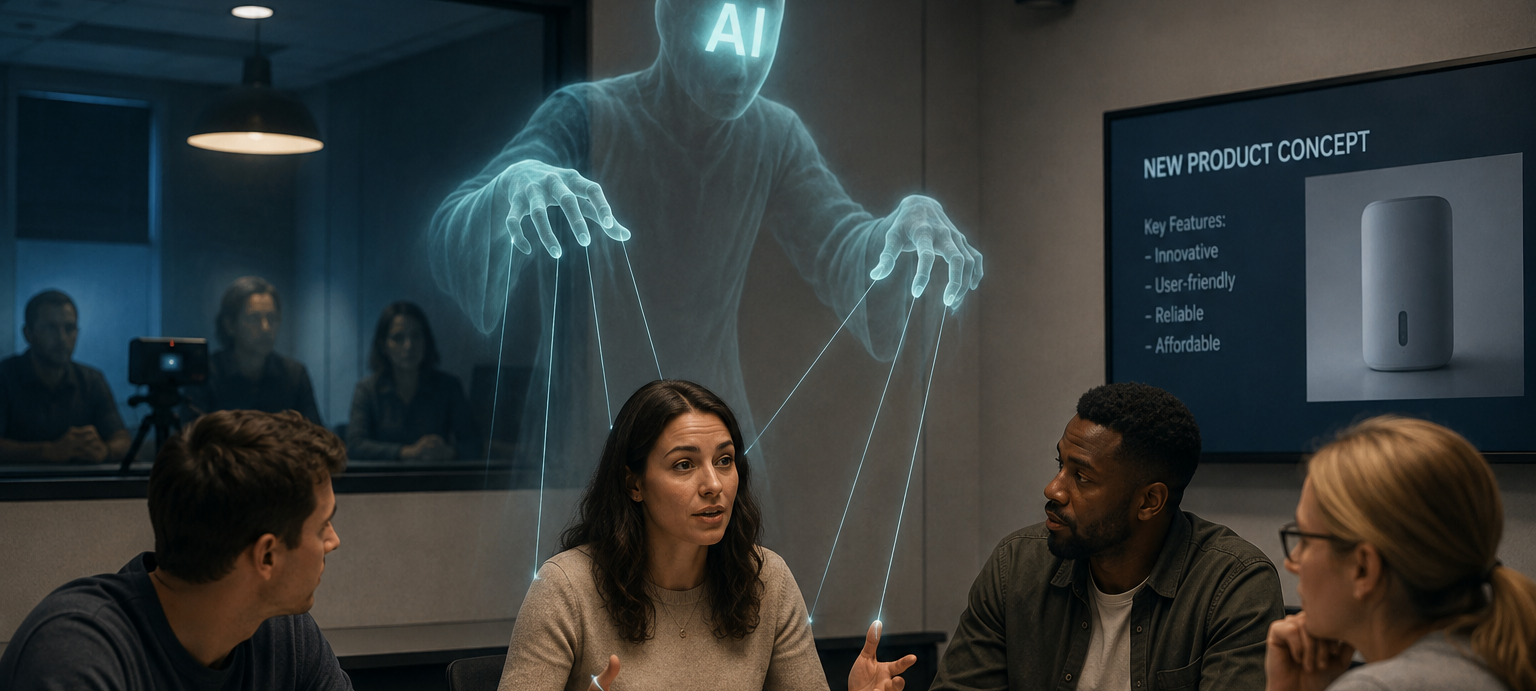
A New Voice in the Room
Physicians have been noticing something. Patients arrive at appointments differently than they used to — more prepared in some ways, more confused in others, carrying printouts or screenshots or the confident summary of a conversation they had, the night before, with an AI. They have researched their symptoms. They have read about their diagnosis. They have, in some cases, already decided what they think is wrong and what they believe should be done about it. The doctor's job, which was always partly the work of understanding how a patient thinks, has become the work of understanding where a patient's thinking came from — and whether the source that shaped it can be trusted.
Qualitative market researchers are beginning to face the same problem. For as long as focus groups have existed, the participant's opinion has been understood as the product of a knowable ecosystem: personal experience, family and community, news and media, advertising, professional advice, and the slow accumulation of cultural exposure. Researchers could not always trace every belief back to its origin, but the general landscape was legible. The sources were finite, roughly shared, and understood.
That landscape has changed. AI is now part of how a significant and growing portion of the population researches candidates, evaluates medical information, compares products, interprets news, and forms opinions on subjects they did not previously know much about. It is fast, authoritative in tone, and available at any hour. For many users, it has become the first stop rather than the last resort. And it is shaping what people believe — often in ways they cannot fully account for, and sometimes in ways that are incomplete, inconsistent, or quietly wrong.
The participant who walks into a focus group today may be carrying a view that was partially constructed by a machine. The researcher who does not know that is working with an incomplete picture — and asking questions built on assumptions that no longer hold.
Where Beliefs Come From Now
The traditional qualitative question — "Why do you believe this?" — has always been somewhat optimistic about the degree to which people can accurately account for their own convictions. Beliefs rarely arrive with clear provenance. They accumulate through exposure, are shaped by context, and are often held with a confidence that exceeds their actual evidential foundation. Researchers have always known this, and good moderators have always probed for the texture beneath the stated view.
But the more useful question, in an AI-influenced environment, may be not just why but how. How did you come to believe this? What was the sequence of information that produced this conclusion? What was the first thing you heard, and what did you do with it afterward?
The answers to those questions now routinely involve AI — and they involve it in ways that vary enormously from participant to participant. One person asked ChatGPT about a medication and accepted the answer without further investigation. Another asked three different AI systems the same question, got three meaningfully different responses, and is now more uncertain than when they started. A third used AI to prepare for a conversation with their doctor, treating it as a research assistant rather than an authority. A fourth has never used AI at all and distrusts it on principle, relying instead on sources that researchers might find equally problematic for different reasons.
Each of these participants may arrive at a focus group with equally confident-sounding views. Without understanding the pathway that produced those views, the researcher has no way to assess how stable they are, how well-founded, or how likely they are to shift when new information is introduced. The belief is visible. The ecosystem that generated it is not — unless the researcher specifically goes looking for it.
"The participant's answer may be the endpoint of an information process that researchers cannot see — unless they specifically ask about it."
— On tracing belief in the AI eraAI as a Research Variable
If AI is now part of the information environment that shapes participant opinion, it follows that AI usage should become a research variable in its own right — something studied, segmented, and factored into analysis rather than left unexamined in the background.
The relevant dimensions are several. Frequency matters: there is a meaningful difference between a participant who uses AI daily as a routine cognitive tool and one who has used it twice in the past year for novelty. Purpose matters: AI used to compare product specifications is functioning differently than AI used to process a cancer diagnosis or evaluate a political candidate's record. Platform matters, perhaps more than researchers currently appreciate: different AI systems produce different answers, frame questions differently, and carry different implicit biases in how they weight and present information. A participant who formed their view using one model may hold a meaningfully different belief than one who used another, even if the underlying question was identical.
Trust and verification matter most of all. What a participant does after an AI gives them an answer reveals more about their epistemic hierarchy than almost any other single data point. Do they accept it immediately? Do they search for confirmation? Do they ask a human expert? Do they consult another AI? Do they compare multiple models and weight the consensus? The answer to these questions describes something fundamental about how this person relates to authority, expertise, and uncertainty — and that relationship will shape every other belief they bring into the research conversation.
The Model Itself Is a Source
There is a further step available to researchers willing to take it. Once the AI platforms a participant uses have been identified, those platforms can themselves be studied. This is not a speculative exercise. If a participant says they researched a medical condition using a particular AI system, a researcher can query that system with similar prompts and observe what kinds of answers it tends to produce — how it frames the condition, what it emphasizes, what it omits, how confident it sounds, and whether its responses vary depending on how the question is asked.
This does not establish that the AI caused the participant's belief. The participant's prior experience, emotional state, and existing framework for interpreting information all mediated whatever the AI told them. But it adds a dimension of understanding that is otherwise invisible. The researcher is no longer simply studying what the participant believes; they are studying the information environment that helped produce the belief — which is, in many cases, where the more important story lives.
Medical research makes this especially vivid. A participant who says "I read that this drug causes X" may have encountered that claim in a peer-reviewed abstract, a patient forum, a news article, or an AI summary that synthesized all three with varying degrees of accuracy. Understanding which of those sources is speaking through the participant changes how the researcher interprets the claim, how much weight they give it, and what follow-up questions they ask. The information pathway is not a footnote to the finding. It is, increasingly, the finding.
When AI Enters the Session Itself
There is an important distinction between AI as an influence on what participants believe before they arrive, and AI as an active participant in the research session itself. The first is a methodological challenge to be understood and accounted for. The second is a methodological threat to be prevented.
A participant who consults an AI during a focus group is no longer responding from their own knowledge, memory, experience, or genuine uncertainty. They are relaying — or in some cases simply reading aloud — a machine-generated answer to a question the researcher intended to be answered by a human. The response may sound confident, coherent, and well-organized, because AI-generated text typically is. It will also be, in the most fundamental sense, not what the research is designed to collect. The researcher is no longer observing how this participant thinks. They are observing how a language model responds to a prompt that a participant typed while the moderator was not looking.
This risk is highest in online research settings, where participants may have any number of browser tabs open alongside the video call — and where the moderator has no reliable way to observe what is happening on the participant's end of the screen. The temptation is not trivial. Online focus groups frequently touch on topics participants feel they should know more about. The gap between what they actually know and what they feel they are supposed to say creates exactly the kind of social pressure that makes a quick AI consultation feel like a reasonable accommodation rather than a violation of the research protocol.
Addressing this requires explicit instruction — clear, specific, and delivered before the session begins — about what constitutes appropriate participation. Participants should understand not only that outside consultation is prohibited but why: that the value of their authentic perspective is precisely what makes the research worth conducting, and that an AI-generated answer, however polished, is worthless to the researcher and ultimately to the participant's own interests in having their genuine views represented.
"A participant consulting AI during a session is no longer responding from their own experience or uncertainty. They are relaying an answer the research was never designed to collect."
— On research integrity in the online environmentThe Case for In-Person Control
The proliferation of online research — accelerated dramatically by the pandemic and never fully reversed — has produced many genuine benefits: geographic reach, scheduling flexibility, reduced cost, and access to participant populations that would be impractical to assemble in a single location. It has also introduced vulnerabilities that the in-person format does not share, and that the AI era has made considerably more consequential.
A professionally staffed in-person facility can do things an online platform cannot. It can provide controlled devices — hardware configured to permit only the applications and websites the study requires. It can monitor participant behavior throughout the session in ways that are simply not available through a video interface. It can ensure, with a degree of confidence that online research cannot match, that the responses being collected are coming from the participant rather than from a source the participant is consulting in real time.
This is not an argument against online research as a method. It is an argument for understanding what each format can and cannot guarantee — and for recognizing that, as AI becomes more accessible and more reflexively consulted, the value of the controlled in-person environment has increased in proportion. For research in sensitive subject areas — medical, political, legal, financial — where the authenticity of participant responses is not merely a methodological preference but a substantive requirement, the ability to ensure that those responses are genuinely the participant's own is increasingly a meaningful differentiator.
FGA's on-site research infrastructure is designed with exactly this in mind. The combination of dedicated technical staff, controlled device protocols, and a facility built for the specific demands of qualitative research creates an environment where researchers can collect participant responses with confidence in their provenance — which is, when the research matters, the only kind of confidence worth having.
Understanding the Ecosystem, Protecting the Session
The future of qualitative research requires holding two things in mind simultaneously: the importance of understanding AI's role in shaping participant opinion before the session begins, and the importance of preventing AI from contaminating the session itself. These are not competing priorities. They are complementary ones, and getting both right is increasingly what separates research that produces genuine insight from research that produces the comfortable illusion of it.
The moderator who understands which AI platforms their participants use, how those platforms tend to respond to the kinds of questions the study is asking, and how different participants weight AI-generated information against other sources is a moderator equipped to ask meaningfully better follow-up questions. They can probe the origins of a stated belief rather than accepting it at face value. They can identify when a participant's confidence is running ahead of their actual understanding. They can recognize, in the texture of an answer, the telltale smoothness of a claim that has been borrowed rather than formed.
That competence — AI literacy in the full sense of the term — is not a peripheral skill for researchers to acquire when convenient. It is becoming a core methodological requirement. The participant's mind is now shaped by an ecosystem that includes AI as a regular and influential contributor. Researchers who do not understand that ecosystem are not studying what they think they are studying. And researchers who do not protect their sessions from it are not collecting what they think they are collecting.
The focus group, at its best, has always been an attempt to create conditions under which people tell the truth — about what they know, what they feel, and what they actually believe, beneath the performance of certainty that social life requires of us. AI does not make that aspiration obsolete. It makes it harder to achieve, and more valuable when it is. The researchers equal to that challenge are the ones who understand the new environment clearly enough to ask better questions within it — and who have built the infrastructure to ensure that, when the answers come, they are coming from the right place. ◆