
Jury Research Beyond Today

For decades, the choreography of litigation research looked largely the same. A rented facility. A mirrored wall. A room of recruited jurors watching presentations that might someday unfold in a courtroom. Behind the glass, trial consultants and attorneys scribbled notes, waiting for the break when participants would file out and the real analysis could begin.
It was a system that worked — and it was built on a fundamental tension that hasn't changed: the people making consequential strategic decisions were separated from the people whose reactions mattered most.
Between sessions, teams debated what jurors meant. Were they confused by the expert witness? Did the timeline land? Was that moment when three jurors crossed their arms a sign of doubt, or coincidence? The answers came later, after transcripts were reviewed, after notes were compiled, after the room had emptied.
In an era where nearly every other industry operates on real-time information, litigation research remained stubbornly retrospective.
That is changing — though not as neatly as the marketing materials suggest.
The Psychology Behind the Problem
Before getting into the technology, it helps to understand why juror research is hard in the first place.
Jury decision-making sits at the intersection of reasoning, memory, judgment, attribution, persuasion, and group behavior (NYU School of Law) — which means that even a perfectly observed mock trial is capturing something messy and human, not a clean data set. Decades of research in cognitive psychology have documented just how many variables are in play. Jurors process information through dual-path cognition: some process evidence carefully and systematically, while others rely more on heuristic shortcuts — quick inferences based on peripheral cues like a witness's confidence or a lawyer's credibility signals rather than the substance of testimony itself.
This is one reason why the "story model" of juror decision-making, developed by researchers Hastie, Penrod, and Pennington, has remained so influential. Jurors attempt to assemble evidence into a coherent whole consistent with their existing knowledge — they are narrative processors, not auditors. (Purdue Business) What this means practically is that a case isn't won or lost on individual facts alone. It's won or lost on whether those facts fit a story that makes intuitive sense.
And that story starts forming much earlier than most attorneys assume. After days or weeks of trial, it's doubtful that jurors have waited until final arguments to make decisions. Each aspect of the trial carries with it the potential of winning or losing — convincing or confusing, capturing attention or inducing inattention. (Advocate Magazine)
If attitudes are forming that early and that continuously, the implications for research methodology are significant. Post-session debriefs capture what jurors remember and are willing to articulate. Real-time feedback captures something closer to what actually happened.

The Rise of Real-Time Juror Insight
Modern trial strategy increasingly depends on identifying the precise moments where attitudes shift — the testimony that creates skepticism, the visual that clarifies a complicated concept, the argument that unexpectedly resonates with someone who shouldn't have been persuadable.
Real-time juror feedback technology was built to capture those moments.
Instead of waiting for a post-session debrief, consultants can now see juror reactions unfold as they happen. Participants record thoughts and reactions while watching presentations, creating a running stream of qualitative data that mirrors the emotional rhythm of the case itself. When multiple jurors flag the same moment of confusion or skepticism, the pattern becomes visible quickly — not in the transcript review two days later.
Because online participants can respond anonymously, they are often more candid about what they like, doubt, or simply do not believe — insights you rarely get in a traditional setting. This candor matters. Self-report data gathered after deliberation is susceptible to memory fallibility and various presentational biases (Wiley Online Library) — people reconstruct what they thought, shaped by what the group ultimately decided. In-the-moment reaction data avoids at least some of that distortion.
For trial strategy, this changes the rhythm of preparation. Attorneys can refine arguments between sessions, adjust presentations overnight, test new approaches and measure whether those adjustments actually moved the needle.
A Digital Layer to the Observation Room
Technology has also changed where litigation research happens.
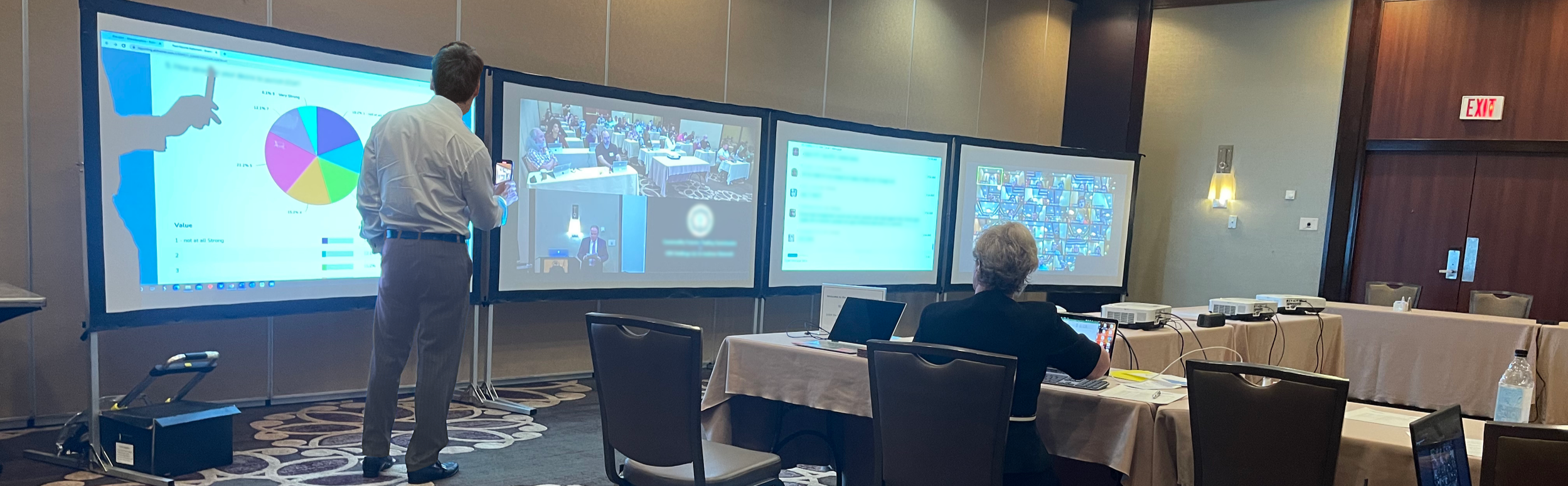
In the past, observing a session required physical presence — attorneys and consultants behind the glass, sometimes flying across the country for a single research day. Platforms like FGA’s LiveView® now allow extended sessions of seven hours or more, with everyone — presenters, observers, and jurors — participating remotely from their own locations.
The growth of online mock juries expands geographic reach, reduces facility costs, and enables flexible scheduling for venue-specific recruitment — which matters considerably when you need jurors who actually reflect the community where the case will be tried, not whoever could be recruited to a downtown facility on a Tuesday.
For national trial teams, the logistical shift is real. A consultant in one state, a partner in another, and a client across the country can all watch the same juror reaction at the same moment. What used to require a travel budget and a blocked calendar can now happen from a laptop.
That said, the transition isn't frictionless. Body language is harder to read through a webcam. Group dynamics in a room are different from group dynamics on Zoom. Some consultants argue the richness of in-person deliberation observation is difficult to replicate online. The better platforms seem to acknowledge this tension rather than paper over it — some services now offer hybrid formats that bridge in-person research and online jury research, trying to capture the advantages of both.
Where Infrastructure Meets Insight
Companies like FGA Research have been working specifically to close the gap between observation and strategy in real time.
Through its LiveView® Notes system, consultants and attorneys can see juror reactions appear as participants watch case presentations — not in batches, not in summaries, but live. Instead of waiting for post-session analysis, trial teams get a running feed of juror commentary, allowing them to identify moments of persuasion, confusion, or skepticism as they surface.
Paired with the LiveView® Platform, sessions can be conducted virtually, with a digital observation room where legal teams collaborate while the research is still in motion. For consultants working across multiple jurisdictions — or testing cases in smaller, harder-to-reach venues — the approach offers a practical advantage that goes beyond convenience. Juror panels can be recruited locally, which is where venue intelligence actually comes from.
The most useful dashboards allow teams to compare juror characteristics with their leanings, understand why views change throughout the mock process, and evaluate how jurors are assessing both sides' witnesses and case narratives — not as a summary at the end of the day, but as a living picture throughout.
The Limits of Any Research Method
It's worth being honest about what mock trial research — however sophisticated — cannot do.
Since legal and institutional hurdles make it essentially impossible to study live criminal jury deliberation, researchers use various indirect methods, all of which carry limitations. Mock jurors know, on some level, that their verdict won't send anyone to prison or cost a company its existence. The psychological weight of an actual jury room is difficult to simulate.
There's also the question of group dynamics. Research on jury deliberation consistently shows that when jurors deliberate with like-minded peers, punitive damage awards can be significantly higher than the median of individual jurors' pre-deliberation preferences — a "severity shift" driven by group polarization. (Iacajournal) Mock trials can study this, but they can rarely fully reproduce it. Individual reactions captured in real time are valuable data. They're not the same as what happens when twelve people enter a room and start negotiating a verdict.
None of this undermines the value of real-time feedback tools. It just means the tools are best understood as one layer in a multi-method research approach, not a replacement for the strategic judgment that experienced consultants bring to interpreting what any of it means.
The Future of Litigation Research
The broader shift mirrors a transformation happening across professional fields. Industries once dependent on delayed reporting now operate on live data. The question for litigation research has been whether the nature of the work — deeply human, qualitative, irreducibly complex — could accommodate the same kind of real-time visibility.
The answer, increasingly, appears to be yes. Not by replacing the observer's instinct, but by giving it more to work with, sooner.
The mirrored observation room hasn't disappeared. But it now has a digital layer — one where juror reactions appear as they happen, patterns become visible while sessions are still running, and strategy can evolve before the room empties.
For trial teams preparing cases where the stakes can reach millions — or sometimes billions — of dollars, that window of time matters. Not because technology makes strategy easier, but because understanding an audience in real time has always been the difference between an advocate who adjusts and one who doesn't.
Sometimes the turning point of a case isn't discovered in the transcript.
It's discovered the moment a juror writes the thought down.